
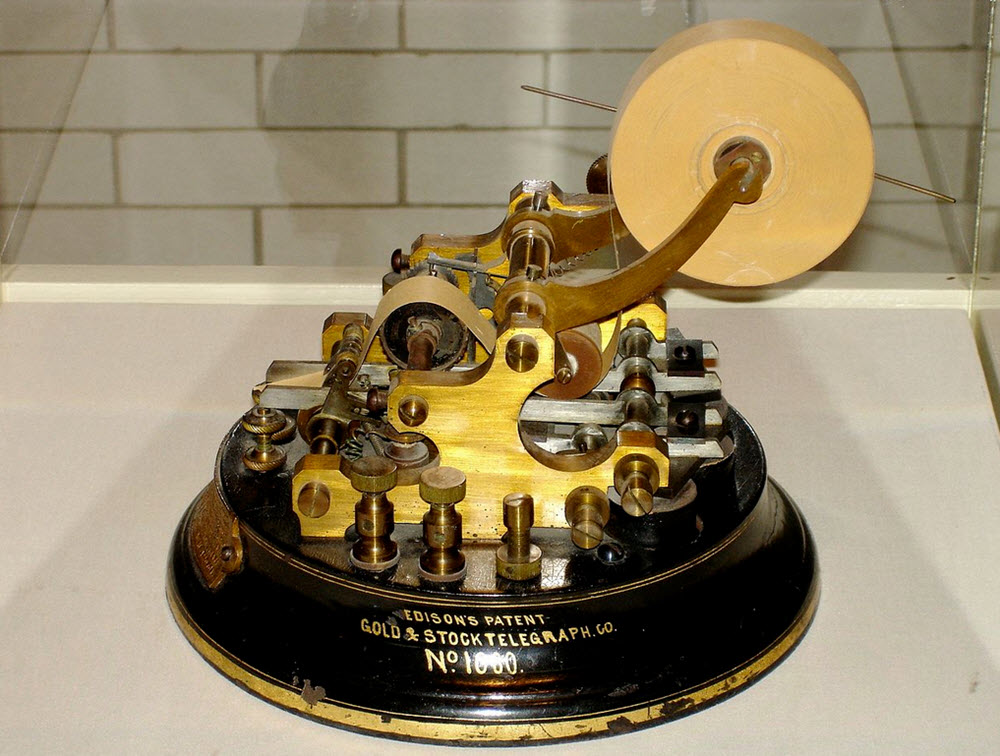
From around 1870, ticker tape was used to transmit stock price information over telegraph lines.
A paper strip ran through a special machine (the stock ticker) which printed abbreviated stock company names (just like today, each listed company had its unique combination of a few letters from the alphabet) followed by a numeric stock transaction price and volume.
While printing, the machine made a ticking sound, and that is why it was called a stock ticker.
The ticker tape had a huge impact on financial market trading, as information from trading floors in different parts of the world could now be transmitted huge distances in a quick and efficient way.
Even though the telephone out-competed the telegraph for a lot of our communication needs during the first half of the 20th century, ticker tape remained in use until 1970 when it was crowded out by early computer networks (and to some extent, television). The basic concepts of the ticker tape still lives on, however, with a few letters being used to denote a listed company share, followed by a few numbers providing us with information about price and volume. Also, we still used the works ”uptick” and ”downtick” to denote if a stock is trading higher or lower than the previous trade.
Stock tickers today
The machines became obsolete in the late 1960s and have not been manufactured since then. In addition to the few that survived from that epoch, working reproductions are also available.
Some stock tickers are displayed in museums, while many others sits in the offices of private collectors.
Financial Telecommunication & The Stock Ticker Timeline
The progression of market data transmission from optical relays to unified trading feeds
The electrical telegraph superseded the optical telegraph system in many countries in the 1840s, and by the latter half of the century most developed countries had telegraph networks that could be used by the public for a fee.
The telegraphic printing system was invented by Royal Earl House in 1846.
In 1854, the new submarine telegraph cable made it possible to telegraph between Europe and North America. This in turn made it possible to telegraph information between major trading hubs across the Atlantic, e.g. between London and New York City.
The telegraphic printing system was greatly improved upon by David E. Hughes in 1856, which helped make it commercially viable. In 1858, George M. Phelps added a resynchronization system.
The first stock price ticker system using a telegraphic printer was created by Edward A. Calahan in 1867 and unveiled in New York City in November that year.
Early stock price ticker systems used the same symbols as Morse code to convey messages.
The Universal Stock Ticker was launched by Thomas Edison in 1869. This machine used letters, numbers and could print roughly one character per second.
As the New York Stock Exchange moved from batch auctions to continuous open outcry trading, real-time demand for printed price feeds accelerated nationwide, making the ticker central to market liquidity.
Before the 1880s were over, more than one thousand stock tickers had been installed in offices in New York City, and the machine had become a symbol of fast-paced trading.
In 1883, a ticker transmitter keyboard was launched that resembled a piano, with black keys for letters and white keys for numbers and fractions. The keyboard was linked to two rotating wheels.
During the dedication of the Statue of Liberty in New York Harbor, Wall Street office workers spontaneously threw discarded ribbons of ticker paper from high-rise windows, inaugurating the American “ticker-tape parade.”
In 1890, members of the NYSE created the New York Quotation Co. and purchased all the other ticker companies. Now, the newly formed company had control over the reporting of price, volume and could prevent conflicting information from causing problems at the trading floor.
The NYSE deployed self-contained 9A high-speed tickers operating at 500 characters per minute to combat catastrophic tape delays that reached up to 100 minutes behind real-time trading during the 1929 market crash.
Electronic cathode-ray tube (CRT) screens, computerized Consolidated Tape Association feeds, and Quotron desk terminals phased out mechanical wheel printing, bringing the physical paper ticker tape era to an end.
How does it work?
A stock ticker prints ticker symbols (normally, the letters representing the stock companies) followed by numbers denoting price and volume. It is all printed on a thin strip of paper – the ticker tape.
But how does it work? Well, pulses on the telegraph line make a wheel in the machine turn. This wheel has characters on it. It will need to turn step by step until the correct character is in position, and then print that.
Back in the early days, a typical 32-symbol letter wheel had to turn – on average – 15 steps to get into position for the next print. Therefore, it would on average print no more than 1 character per second. In the 1930s, faster stock tickers became available.
What´s a ticker tape parade?
When stock tickers were ubiquitous in the offices of lower Manhattan, a tradition emerged where ticker tape was thrown out of office windows during parades. The tapes could be thrown out as whole opened spools to function as party streamers, or be cut up into confetti first.
To very famous ticker tape parades in Manhattan were the ones celebrating the ends of World War I and II, respectively.

